In the Studio with Nurit Avesar
Keystone Art Space Artist Interview
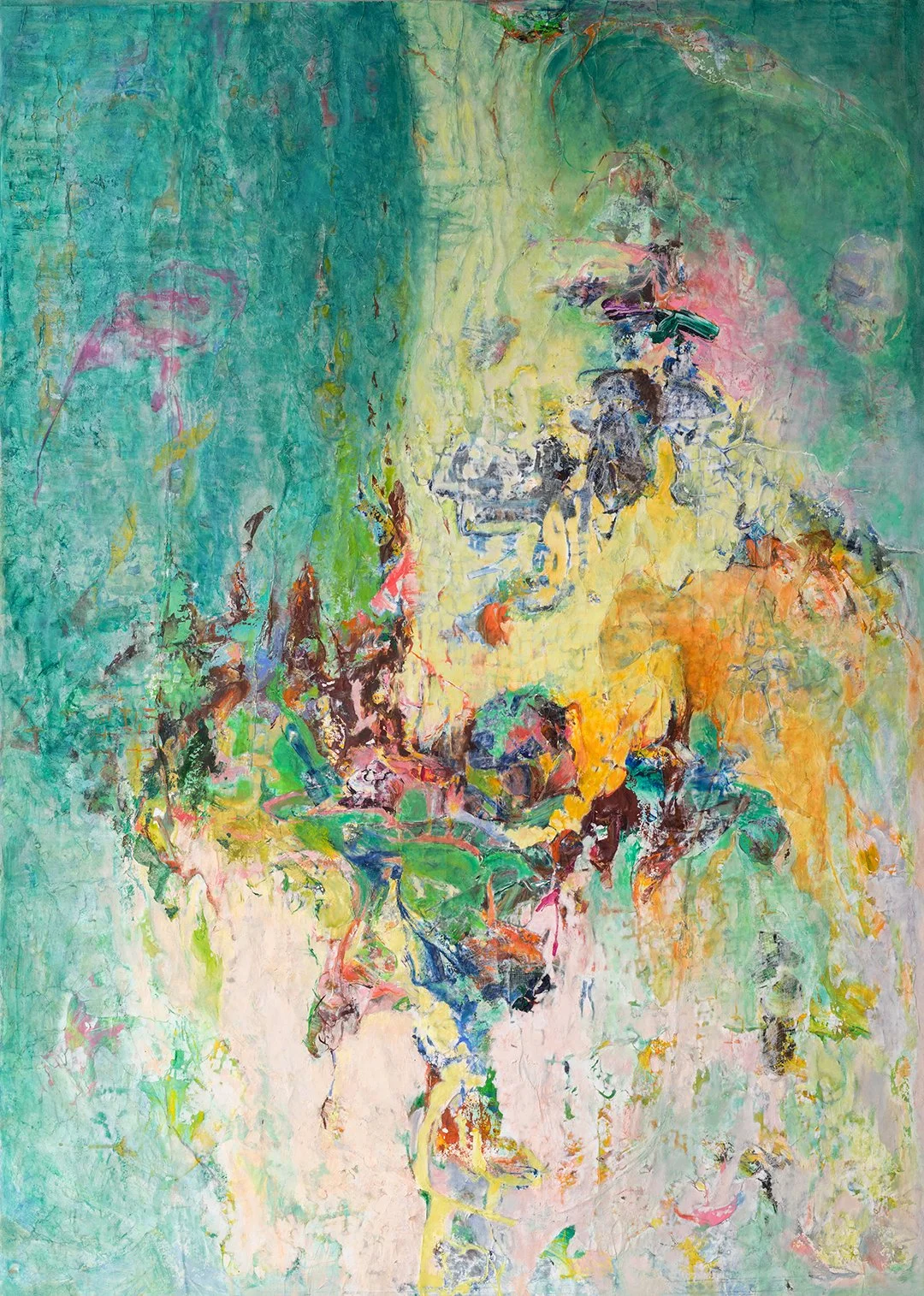
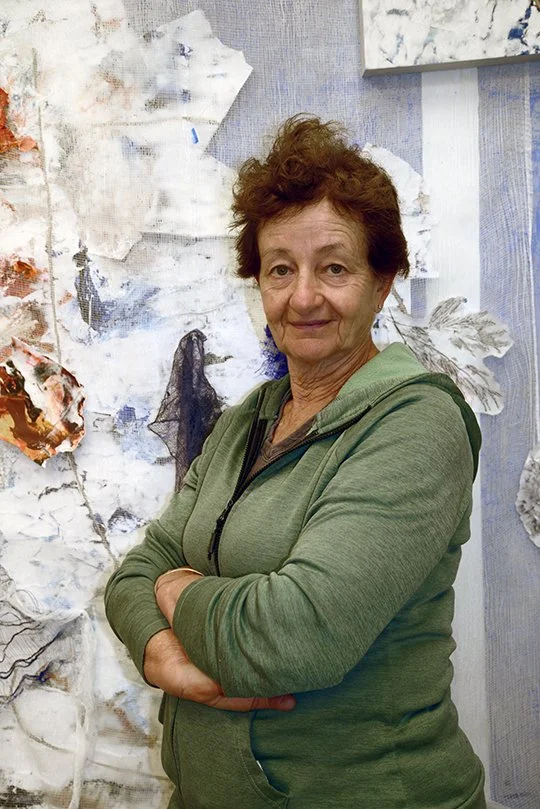
Nurit Avesar’s paintings and mixed-media works invite us into landscapes that feel at once organic, abstract, and deeply connected to the world around us. Through layers of painted paper, oil paint, fabric, wire mesh, rust, and other found materials, she creates richly textured compositions that suggest natural processes of growth, erosion, transformation, and renewal. Beneath their visual energy lies a more sobering subject: the ways the past shapes the present, the consequences of human decisions, and the uncertain future we are creating for the next generation.
Avesar is currently preparing for The Pull of the Sun, her first solo museum exhibition, which will take place at MOAH: Cedar in Lancaster February 6-March 14, 2027. The exhibition brings together paintings and a large-scale installation inspired in part by the myth of Icarus and the environmental forces of water and fire.
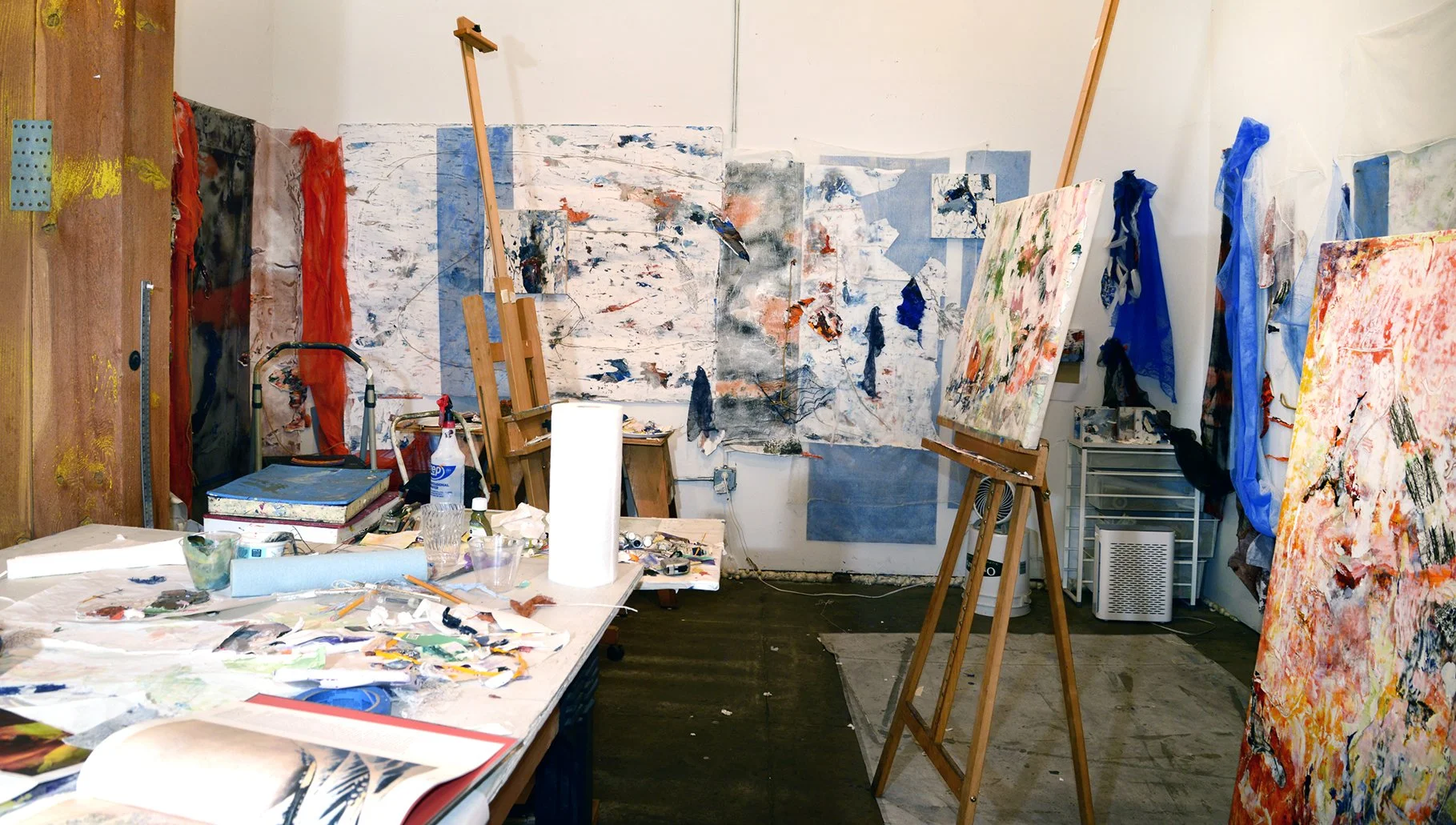
I visited Nuit in her studio at Keystone Art Space to talk about her process, her materials, and the ideas that have continued to evolve throughout her work.
Building a Painting, Layer by Layer
Julie Green: Tell me about your process. Your work combines so many different materials—paint, paper, collage, and found elements. Where do you begin?
Nurit: I start with a very free, abstract expressionist painting on paper. Then I add another layer of paper on top of it. I sand it, tear it, and work into it. I have lots of pieces of paper around the studio that come out of this process.
Once I have something I want to work with, I use it as a base for a painting. I adhere it to canvas with gel medium, and then the final stage is painting with oil paint.
I leave a lot of the paper visible in the finished work. Sometimes there is more oil paint, and sometimes there is less. It becomes a combination of the original paper, the collage, and the painting.
Julie: So there's both an additive and a reductive process. You're building up the surface, but you're also taking things away.
Nurit: Yes. It's a matter of deciding what to leave and what to take out.
Julie: And how do you make those decisions? Is there a theme in your mind that guides you, or do you respond to what happens as you work?
Nurit: The process is intuitive. I don't work from a sketch. Sometimes I have an idea, but I don't necessarily know where I'm going. I might cut a piece of paper because I want to make it smaller, and then I realize I need it. I might add something and then cover part of it with oil paint.
I work on several pieces at once. It takes a lot of time to look at them, think about them, and decide what needs to happen next. Sometimes a painting takes months or even years to finish.
Julie: I can see that. There's a wonderful tension between the freedom of the initial marks and the very deliberate decisions you make later. Your eye moves through the composition, but there are also places where it can rest. That's not always easy to achieve in abstract expressionist work.
Nurit: Abstract painting is challenging, and I like that challenge. You have to keep looking and thinking. Sometimes you don't know whether something is working or whether you need to change it.
The Past, Present, and Future
Julie: You've worked in a number of different styles throughout your career. You mentioned that you used to be a figurative artist and an illustrator. What ideas have stayed with you through those changes?
Nurit: I've done many different bodies of work, but one idea has stayed with me for a long time: how the past influences the present and the future.
It's not linear. History is also a personal thing. The past reflects who we are, and it continues to influence what happens next.
That idea is present in the way I work. I cover a surface, but the earlier layers still show through. Then I add another layer, and something new appears. The previous layers don't disappear completely. Everything is connected, almost like a mesh.
Julie: That's such a compelling parallel between the physical process and the ideas behind the work. The earlier layers remain present even when they're partially concealed. Nothing is entirely erased.
Nurit: Exactly. It's circular rather than linear. Everything is there together.
Julie: You've been developing this body of work for quite a while, haven't you?
Nurit: I think the first work in this series was made in 2014. I've been working with these ideas for many years.
Julie: That makes sense when you see the work together. The individual paintings can look quite different, but there's a coherence running through them. And because your process involves so much chance, you never know exactly what a particular piece will become.
Nurit: That's right. Even when I glue the papers together, I might take pieces from different sections of several works and combine them. Sometimes a composition emerges that I wouldn't have planned.
Julie: Some of the pieces begin to look like landscapes. I see horizons, geological formations, and organic shapes. Other works are more ambiguous, but they still seem to suggest a sense of place.
Nurit: Yes. Sometimes they become landscapes, even though I don't begin with that intention.
Material as Memory
Julie: One of the things I love about your work is that the materials have such a strong physical presence. Some surfaces resemble bark or eroded stone. Others look burned, weathered, or almost digitally pixelated. How did you begin experimenting with these materials?
Nurit: I use whatever I can find that works. I use string, window screen, cheesecloth, different kinds of paper, and rust. I have been working with rust for a long time.
Years ago, I put paper on a piece of brass furniture and left it outside in the rain. The rust transferred onto the paper, and I ended up with all these beautiful marks. I've kept that paper for years and still use it in my paintings.
Sometimes I combine it with rice paper or other materials. I also peel layers from different surfaces and use those. The material already has a character of its own.
Julie: So you're not simply adding a texture to the painting. You're allowing the material to bring its own history into the work.
Nurit: Yes. The rust, the paper, and the other materials have already gone through a process of transformation. I like what happens when I bring them together.
Julie: I can see that in the burned paper, too. The edges have their own shape and history. They remind me of burned trees and the aftermath of fire.
Nurit: Some of the pieces are actually burned. I burn parts of the paper or canvas, then adhere them to another surface and sometimes enhance them with paint. I also use illustrations and other original papers that I've made or kept.
Julie: Your background in illustration seems important here. There are passages of line and drawing within the abstract compositions, but they don't announce themselves immediately. They become part of the structure.
Nurit: Before I began working this way, I did commercial art and illustration. I worked by hand and made very realistic images, including portraits. I can still draw realistically when I need to. Sometimes I incorporate that kind of imagery into a painting.
Julie: That range of experience gives you so many possibilities. You can move between the gestural, the geometric, the organic, and the representational without any one of those elements taking over.
I also noticed the window screen and cheesecloth in some of your work. They create a repeated pattern that can read almost like a digital image.
Nurit: Yes. Sometimes the screen creates that effect. The pattern becomes very regular, and it starts to look like pixels.
Julie: It's interesting that a material as ordinary as window screen can make us think about the digital world. We are so accustomed to looking at images through screens that we can begin to read a physical surface in the same way.
Nurit: That's true. I like to experiment with materials and see what happens. Sometimes the results surprise me.
From Painting to Installation
Julie: Your upcoming exhibition is an exciting development because you're moving beyond individual paintings into a larger installation. How are you approaching that?
Nurit: The exhibition will have three rooms. One room is dedicated to the installation, another will have paintings, and there is a hallway where smaller works will be shown.
I'm preparing a number of mixed-media elements for the installation. Some are made from painted cheesecloth, paper, and window screen. Others incorporate branches and other materials. I'll prepare a collection of pieces in advance and then arrange them in the space.
I will have a few days to install everything, so I want to arrive with enough material to experiment with the arrangement.
Julie: That gives you room to respond to the architecture rather than deciding every detail in advance. I can imagine the installation evolving as you see how the pieces relate to one another.
Nurit: Exactly. I'll prepare the elements, but I won't know precisely how everything will work together until I get there.
Julie: Some of the pieces have a beautiful sculptural quality. The paper seems to peel away from the surface, and the branches introduce another dimension. They begin to feel like fragments of a natural environment.
Nurit: I want to explore that more. I've thought about making some of these elements with paper clay or another material that would let me develop the sculptural aspect further.
Julie: That could be a wonderful extension of what you're already doing. The physical materials are central to the paintings, so moving into three dimensions feels like a natural progression.
The Pull of the Sun: Icarus, Fire, and Water
Julie: Tell me about the title of the exhibition.
Nurit: It's called The Pull of the Sun.
Julie: The title immediately brings Icarus to mind, and I know that the myth has been important to your work. How does it connect to the ideas behind this exhibition?
Nurit: I've been working with Icarus for a long time. The myth has become more complicated for me as the environmental situation has become more complicated.
I think about the decisions made by older generations and how younger generations end up paying for them. There is vanity, ambition, and the abuse of power. Icarus wants to fly, and his father makes wings for him. His father warns him not to fly too close to the sun or too close to the water, but Icarus doesn't listen. He flies toward the sun, his wings fail, and he falls into the sea.
The father is left to recover his son's body. It's a tragic story.
Julie: And it becomes an analogy for what we're experiencing now. The consequences of decisions made by people in power can reverberate far into the future. Younger generations inherit problems they didn't create.
Nurit: Yes. It's sad because it keeps happening. We don't seem to learn as a species.
Julie: Your work has so much movement, energy, and color, but the ideas beneath it can be quite serious. The myth gives you a way to address those ideas without illustrating the story literally.
Nurit: I think about the environment, but it's no longer just about the environment. We are dealing with wars, artificial intelligence, and political decisions whose consequences we don't yet understand. The problems are interconnected.
I'm from Israel, so the consequences of war are not abstract to me. They remain with people for a long time. The next generation often pays the price.
Julie: That sense of consequences accumulating over time seems closely related to the way you build your surfaces. One layer is never entirely separate from the layer beneath it.
Nurit: Yes. That's part of the idea.
Julie: Water and fire are also prominent in the work. Both are natural forces, but they have become especially charged in the context of climate change and environmental destruction.
Nurit: I have been thinking about how to incorporate those elements into the installation. I may bring the ideas together rather than separating the work into distinct sections about water and fire. I'll see what makes sense once I begin installing.
Julie: I like the idea of allowing the elements to coexist. Water and fire can seem like opposites, but both are forces that can transform a landscape. And in the story of Icarus, the sun and the sea are both part of the tragedy.
Nurit: Exactly. The installation will include two wing-like forms suspended in the middle of the room. I'm still working out how to construct them, using branches and paper-based materials.
Julie: Will the wings have burned edges, perhaps echoing the myth?
Nurit: I hadn't decided that yet, but it's something I could consider.
Julie: It would be interesting to let the materials carry that part of the story. The wings could suggest flight and possibility, while their surfaces hint at the consequences of getting too close to the sun.
Nurit: Yes. I still have to work through those decisions.
Color, Movement, and the Space Between
Julie: Even when you're working with difficult subjects, your paintings have a remarkable vitality. The color is often joyful, and there's a sense of movement throughout the compositions. How do you think about color as you're working?
Nurit: It depends on the painting. Sometimes I begin with a particular color, but I don't necessarily know where it will go. I might decide that one section needs to be blended more or that an edge is too sharp. I continue to adjust it.
I work slowly. I look at the painting, make a change, and then look at it again. I may work on several paintings at once because I need time to think about each one.
Julie: I noticed that some of the works have a strong sense of geography. The shapes can suggest coastlines, islands, or distant horizons, even though the paintings are abstract.
Nurit: Yes, and sometimes I recognize that quality only after the work has developed.
Julie: I also see a connection to Japanese prints in some of your compositions, particularly in the use of space and the way a high horizon can balance a dense area of detail. Have those artists influenced you?
Nurit: I love Japanese woodblock prints, particularly the work of Hiroshige and Hokusai.
Julie: What interests me is how they create depth without relying on conventional perspective or dramatic cast shadows. They can make a landscape feel expansive through the arrangement of shapes, color, and line. I see something related in your paintings. You can have an area filled with intricate marks and textures, and then a relatively quiet passage gives the eye somewhere to rest. That contrast creates a wonderful rhythm.
Nurit: I think about those relationships as I work. Sometimes I have to remove something or cover part of it. The painting needs to find its own balance.
Julie: There's a real conversation between the parts of the composition. The repeated segments, the broken lines, and the overlapping shapes create tension, but they also give the work a sense of flow.
Nurit: That's part of the challenge. I don't always know at the beginning what a painting will become. I have to keep working and see what develops.
Working Through Uncertainty
Julie: You've described a process that depends on experimentation, but also requires a great deal of patience. How do you know when a painting is finished?
Nurit: It's difficult. Sometimes I think I'm finished, and then I look at the work again and realize something needs to change. I may work on a piece for months or years.
I can also change my mind completely. I might be preparing a piece of paper to use in a particular way, then decide it works better somewhere else. I don't want to commit too early to an idea.
Julie: That openness seems essential to your process. You're allowing the materials to suggest possibilities rather than forcing them to fit a predetermined plan.
Nurit: Yes. I work intuitively, which can take more time and sometimes creates more frustration. But I like discovering something I didn't expect.
Julie: And because you work with so many different materials, the possibilities are almost endless. A piece of paper that doesn't work in one painting might become the starting point for another. A burned fragment or a rusted surface can sit in the studio for years before finding its place.
Nurit: That's right. I keep a lot of material. I never know when I might need it.
Julie: There's something fitting about that in relation to the themes of your work. You preserve these fragments of earlier processes and bring them into new compositions. Their histories remain visible, even as they take on new meanings.
Nurit: Yes. The materials keep changing, and I keep finding new ways to use them.
A New Chapter
Julie: The Pull of the Sun will be your first solo museum exhibition, and it's also an opportunity to create a much larger installation than you've done before. How are you feeling about it?
Nurit: It's exciting, but it's also a lot of work. I've exhibited in museums before, but this will be my first museum solo show. And the installation will be larger than anything I've done previously. There are paintings to finish, photographs to prepare, and all the installation elements to make. I have a lot to do.
Julie: It sounds like a wonderful opportunity to bring together so many strands of your practice: painting, collage, drawing, sculpture, and installation.
Nurit: Yes. I'm looking forward to seeing how everything works together in the space.
Julie: The exhibition will be at MOAH: Cedar in Lancaster, from February 6-March 14, 2027. It's a distinctive space, with several rooms and a hallway, so visitors will be able to experience the work in different ways as they move through it.
I'm particularly interested in how the suspended wings and the installation elements will relate to the paintings. The individual works already have a strong physical presence, and I can imagine the larger environment creating another layer of meaning.
Nurit: I hope so. I'll prepare the pieces, and then I'll work with the space to see what happens.
Finding Community at Keystone Art Space
Julie: Before we finish, I'd love to ask about your experience at Keystone Art Space. How long have you been here?
Nurit: I first came here around 2016. I left for a while and returned after the pandemic, around 2021 or 2022. I've been here consistently for the past few years.
Julie: What has it been like working here?
Nurit: It's a great space, with wonderful artists and a lot of support. I have been very happy here.
I used to work in a studio in the garage of my house in Mid-City. People come to visit me here much more often. It's good exposure, and curators seem to approach the work differently when they come to an established artist community.
Julie: There's something valuable about having that kind of visibility, but also about being surrounded by other artists.
Nurit: Definitely. It's important to know people, communicate, and have camaraderie with other artists. And it's helpful to have someone around when you need assistance with something in the studio.
Julie: That exchange is one of the things that makes an artist community special. You have your own practice and your own space, but you're also part of a larger network of people who understand what it means to make work, solve problems, and keep going.
Nurit: Yes. It's a special place, and it's difficult to replicate.
Julie: Nurit, thank you for sharing your process and your ideas with us. It's been wonderful to see how you work with materials, how you allow the paintings to evolve, and how those experiments connect to the larger themes of history, environmental change, and the responsibilities we have to future generations.
I'm looking forward to seeing The Pull of the Sun at MOAH: Cedar February 6-March 14, 2027
Nurit: Thank you. I'm looking forward to it, too.
Julie Green is an artist and interviewer working with Keystone Art Space to share conversations with artists about their work, creative processes, and evolving practices.