
Natasha Rudenko
Road of Life
July 3rd - July 13th
Join us for the closing reception of Road of Life on Saturday, July 11, from 5-9 pm.
Artist talk with Natasha Rudenko: 6pm
Artist Natasha Rudenko will lead a walkthrough of the exhibition, The Road of Life, on Saturday July 11 at 6pm. She will discuss the making of the work, the stories behind the photographs and her process in regards to the installation of her exhibition.
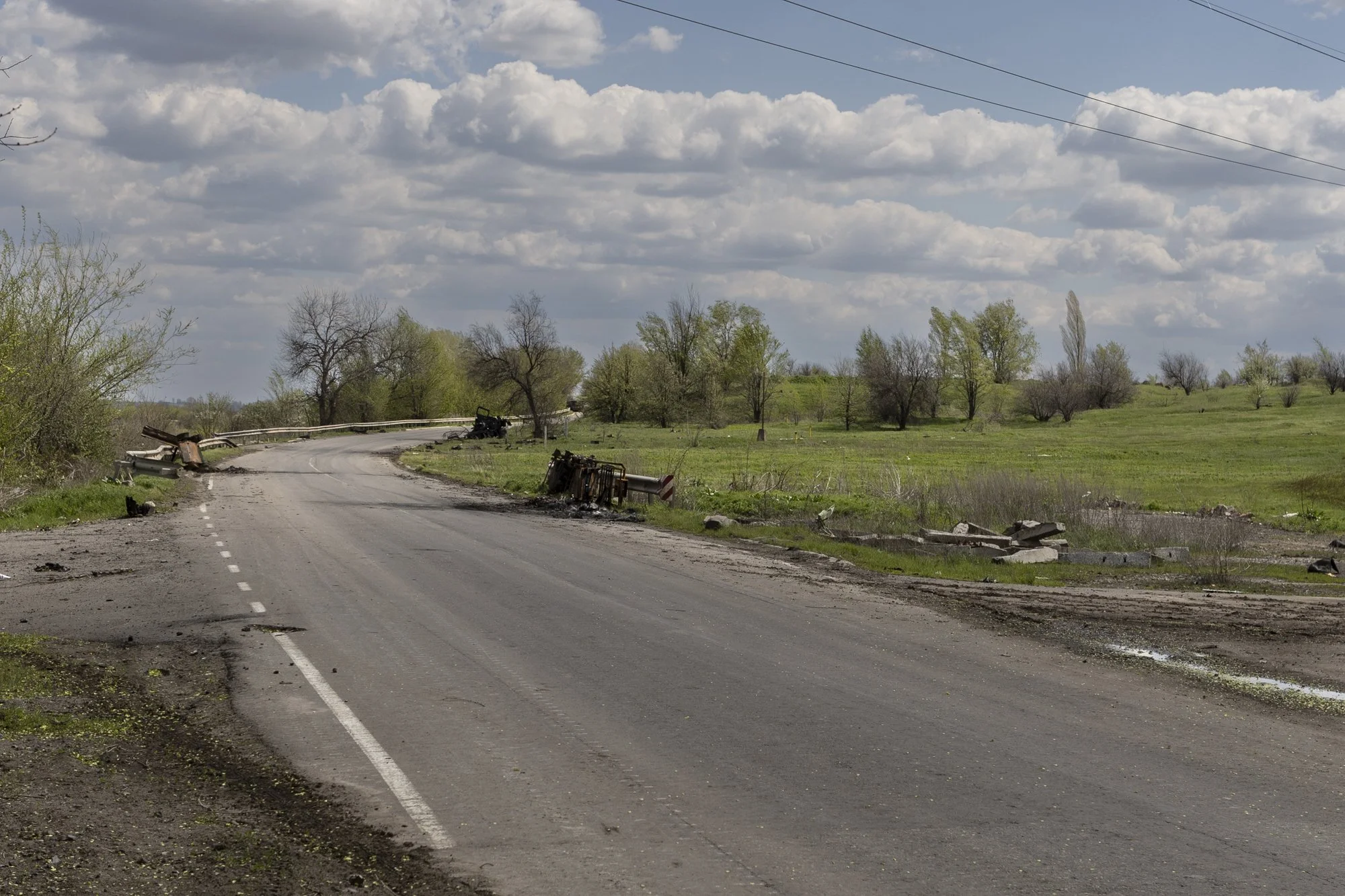
Rudenko will reflect on her experience of joining civilian evacuations in Ukraine’s Donetsk region as a documentarian during the spring of 2026 as well as how these experiences shaped the creation of Road of Life.
About the exhibition:
Documentary photographer and visual artist Nataliya Rudenko invites you to their solo exhibition “Road of Life”, a powerful and intimate multi-media reflection on displacement and complex trauma of the prolonged war in Ukraine.
As Russian attacks intensify and the frontline moves closer, residents of towns and villages across eastern Ukraine are forced to make impossible decisions. Carrying only what they can take with them, they leave behind homes, possessions, pets, gardens, and lives built over decades, departing with no certainty of when, or if, they will return.
Many volunteer evacuation teams work across the Donetsk region, helping civilians leave frontline communities. In March and April 2026, Natasha joined the team of volunteer project “Road of Life” with whom they evacuated approximately 200 people from the town of Druzhkivka and nearby villages. Located roughly 8 miles from the frontline, these communities now fall well within the reach of modern drone warfare. In the current war, the so-called "kill zone", the area within which armed drones can identify and strike targets, extends up to approximately 19 to 20 miles from the frontline.
The portraits bear witness to this moment of departure. Photographed at the doorsteps of lost homes, along evacuation routes and at collection points, they depict individuals and families suspended between the lives they once knew and an uncertain future elsewhere. Their expressions, belongings, and presence speak not only to displacement, but also to the quieter realities that precede it.
Contemporary warfare is increasingly experienced not as a sequence of isolated events but as an ongoing condition. Missile strikes, drone attacks, air raid alarms, and the constant possibility of violence create an environment in which uncertainty becomes embedded within ordinary existence. Over time, people adapt. Air raid alarms become background noise. Protective measures become routine. Visible signs of war merge into the landscape of everyday life. Sounds, objects, and experiences that elsewhere signify safety, leisure, or normalcy acquire entirely different meanings. The buzz of a drone overhead becomes a warning. The sound of gunfire can signal protection.
Through photography, installation, sound, and video, the exhibition invites viewers to encounter this altered reality. The portraits on the walls stand as witnesses to experiences that cannot be fully captured by statistics, maps, or reports. Looking back at the viewer, they connect the abstract realities of war to individual lives, reminding us that displacement begins long before the moment of evacuation. It begins when uncertainty, fear, and adaptation become woven into the fabric of everyday life.
About Natasha Rudenko
Natasha Rudenko is a fine art photographer and multimedia visual artist whose work explores identity, belonging, displacement, and the human condition. Holding an MFA in Photography from the New York Film Academy, they often use photography as a form of self-inquiry, employing self-portraiture and performative image-making to examine their experiences as a feminist, immigrant, and white female-presenting non-binary artist. Their work investigates the fluid relationship between selfhood, memory, and representation, positioning the artist as both creator and subject.
Since the start of Russia's full-scale invasion of Ukraine, Natasha's practice has increasingly focused on documenting the lived realities of war. Through photography, video, and installation, they explore the emotional, psychological, and physical consequences of conflict, with particular attention to displacement, adaptation, and everyday life under conditions of ongoing threat. Their recent solo exhibition, The Doors of The House Rust Hopelessly (2025) at Keystone Gallery in Los Angeles, examined the aftermath of war and the traces it leaves on people and places. Their earlier solo exhibition, Be/longing (2022), explored themes of identity, immigration, and belonging.
Alongside their artistic practice, Natasha is an educator and humanitarian organizer based in Los Angeles. They teach photography and visual culture at institutions including the New York Film Academy and UCLA Extension, developing inclusive, culturally sensitive curricula that encourage both technical proficiency and critical thinking. Natasha also serves as Vice President of Post Angeles, a nonprofit organization delivering humanitarian aid to Ukraine. Their work has been exhibited internationally and published in feminist and queer art publications, reflecting an ongoing commitment to visual storytelling as a tool for reflection, dialogue, and social engagement.